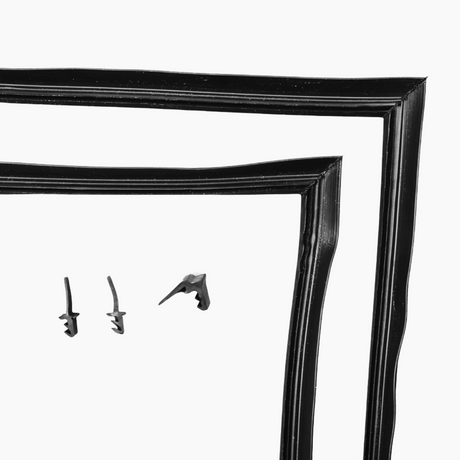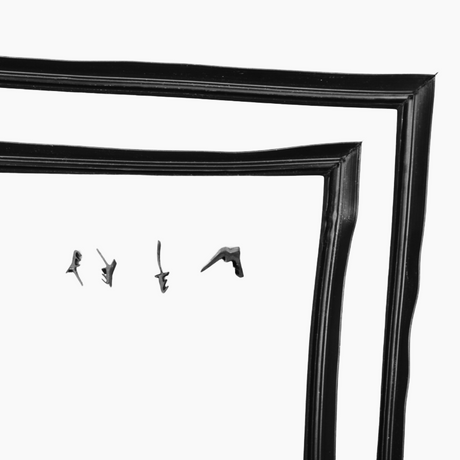

The difference between the old and new rubber package in a GU lift-slide door
With GU lift-slide doors, the construction of the rubber package around the center stile has changed over the years. This is not a detail, but a fundamental structural difference that greatly affects sealing, closing force, and durability.
In practice, we see that many problems arise because the wrong type of rubber package is used, or because the distance between the center stiles is not taken into account. In this blog, we explain step by step how it works.
The old type GU rubber package (classic version)
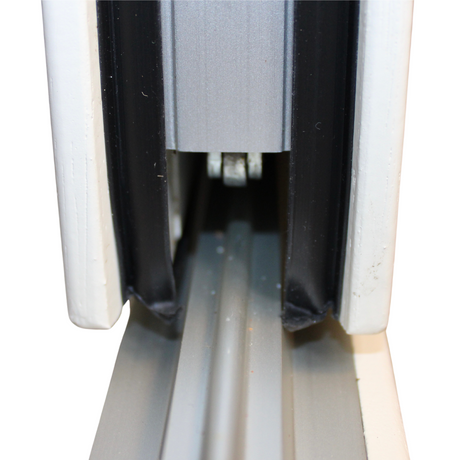
In the old type GU lift-slide door, the sealing around the center stile is divided over the fixed frame and the sliding door. This means that fixed and moving parts together are responsible for the sealing.
Mullion – fixed frame side
On the center stile of the fixed frame, this type has three rubbers:
✔ P1483
This rubber is mostly on the outside and forms the primary seal against rain and wind.
✔ P743 mullion rubber
This rubber is positioned more inward and provides extra sealing and pressure build-up.
Mullion – sliding door side
Unique to the old system is that there is also a rubber on the mullion of the sliding door itself:
✔ P743 mullion rubber on the sliding door
This rubber moves with the sliding part and seals against the rubbers of the fixed frame.
👉 The old GU system therefore works with rubber-on-rubber contact between fixed and sliding parts.
Rubbers that are the same in old and new
Despite the differences around the mullion, there are also rubbers that are identical in both versions:
✔ 2 × P743 corner rubbers
These are located on the corners of the sliding door and provide sealing in corner situations.
✔ 1 × P1156 top rubber
This rubber is on top of the sliding door and provides sealing when closed.
These parts do not change when transitioning from old to new type.
The new type GU rubber package (modernized version)
In the new type GU lift-and-slide door, the sealing around the mullion is structurally simplified. All sealing is now concentrated on the fixed frame.
Mullion – fixed frame side
These are now located here:
✔ 2 × P1483 on the mullion of the fixed frame
✔ No more P743 on the mullion
✔ No additional rubbers on the sliding door
Mullion – sliding door side
With the new system, the following applies:
✔ ❌ No more rubbers on the mullion of the sliding door
✔ The sliding door closes directly against the P1483 rubbers of the fixed frame
👉 The rubber-on-rubber principle has been abandoned. The sealing now comes entirely from one fixed side, which provides a clearer and more stable sealing principle.
Distance between mullions determines the correct P1483
This is one of the most important points of attention with the new GU rubber package.
The P1483 is available in two different thicknesses:
✔ P1483 – 10 mm
✔ P1483 – 14.5 mm
Which version is needed is entirely determined by the distance between the mullion of the fixed frame and the mullion of the sliding door when the facade is closed.
✔ Smaller distance → P1483 of 10 mm
✔ Larger distance → P1483 of 14.5 mm
This distance varies per GU profile, year of construction and version. Therefore, the rule here is always: measuring is necessary.
What happens with a wrong choice?
✔ Rubber too thin → insufficient sealing, drafts and leakage
✔ Rubber too thick → heavy closing or poor locking
✔ Unnecessary wear on carriages and locking parts
Overview: old versus new GU rubber package
✔ P1483 on fixed mullion
Old: 1× (10 mm or 14.5 mm)
New: 2× (10 mm or 14.5 mm)
✔ P743 on fixed middle stile
Old: yes
New: no
✔ P743 on sliding door middle stile
Old: yes
New: no
✔ P743 corner rubbers
Old: 2×
New: 2×
✔ P1156 top rubber
Old: 1×
New: 1×
Order GU rubbers via Openingstechnieken.com
The right GU rubbers for lift-and-slide doors are directly available via
Openingstechnieken.com, including:
✔ P1483 (10 mm and 14.5 mm)
✔ P743 corner and middle stile rubbers
✔ P1156 top rubbers
As a specialist in GU parts and lift-and-slide door renovation, we help customers daily in correctly determining the right rubber set.
A correct choice prevents errors, extends the lifespan of the GU system, and ensures a smoothly closing, draft-free lift-and-slide door.